
If you’re learning Japanese, you’ve probably felt this at some point:
- You know a word when you see it…
- But you can’t recall it quickly in conversation
- Or you’re unsure about the nuance (similar words that don’t feel the same)
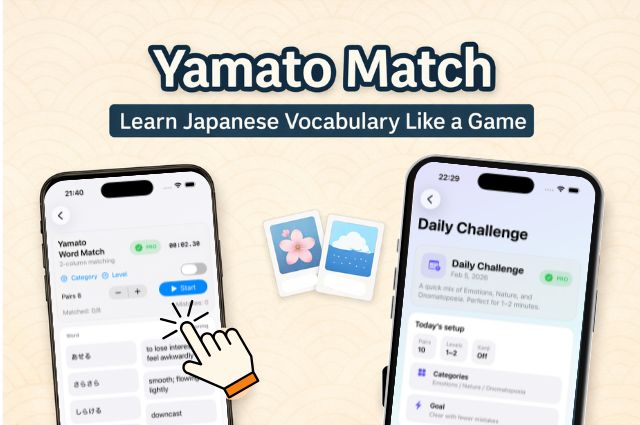
Yamato Match is a vocabulary-learning app designed to fix exactly that—by turning word study into a fast, satisfying matching game that trains recognition, meaning, and usage.
In this post, I’ll introduce what Yamato Match is, how it works, and why it’s especially useful for beginners and early intermediate learners.
Yamato Match is an app I created as a Japanese native speaker to help learners build vocabulary through quick, game-like matching—especially for words with nuance.
What is Yamato Match?
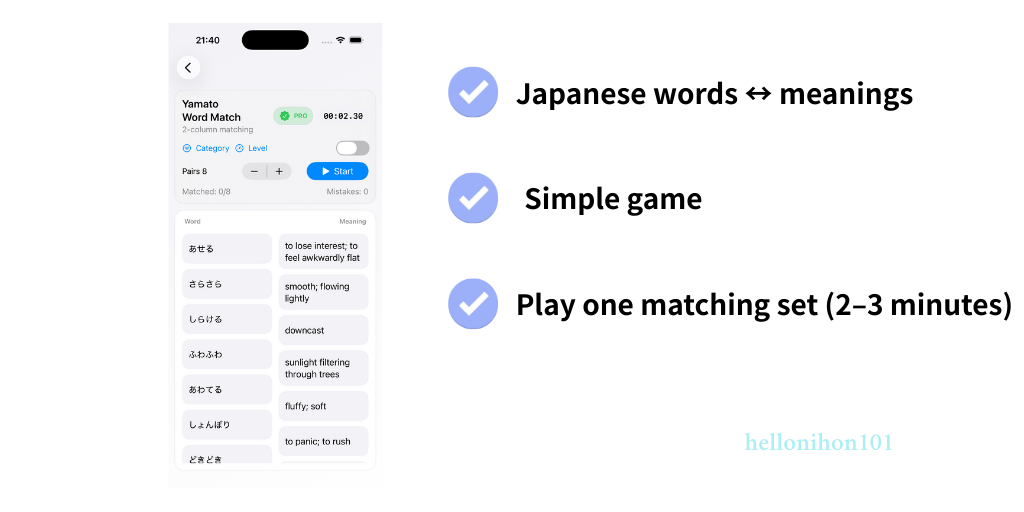
Yamato Match is a Japanese vocabulary matching game where you connect words across two columns—like a “pairing” puzzle.
Instead of passively reading lists, you actively match:
- Japanese words ↔ meanings
- words ↔ example sentences
- words ↔ nuance explanations
- (and in some modes) words ↔ pronunciation practice
This makes it easier to remember words quickly—the way you need them in real life.
Why “Yamato” Match?
“Yamato” (大和) often refers to Japanese-native words and expressions, including words with cultural nuance, emotion, and texture.
The app focuses on vocabulary that helps learners sound more natural and understand Japanese more deeply—especially the kind of words that don’t translate perfectly into one English word.
Core Features (What You’ll Actually Do)
1) Two-Column Matching (Simple, Addictive, Effective)
You’ll see two lists and match the correct pairs as quickly as possible.
This format is powerful because it trains:
- instant recognition
- fast recall
- error correction (your brain learns why something was wrong)
2) Nuance-Friendly Learning
Japanese has many words that look similar in translation but feel different in real usage.
Yamato Match aims to help with that “close but not quite” zone by teaching:
- subtle differences
- typical contexts
- natural phrasing
3) Example Sentences (So You Don’t Learn Words “Alone”)
Instead of memorizing isolated words, you see them in short, realistic sentences.
That helps you learn:
- typical grammar patterns
- collocations (words that commonly appear together)
- natural usage
4) Pronunciation Practice (When You Want It)
Matching gets you fast recognition, and pronunciation practice helps convert recognition into speaking.
A good routine is:
- Match for speed
- Review mistakes
- Practice pronunciation for the words you miss most
What You Can Learn With Yamato Match
Here are common categories that work especially well in matching-game form:
✅ Emotions & Feelings (感情)
Emotion words are everywhere in conversation, anime, dramas, daily talk—and many have “untranslatable” nuance.
Examples of what learners often struggle with:
- “happy” ≠ one word
- “sad” has multiple shades
- “nostalgic” has a uniquely Japanese feel
✅ Nature & Seasons (自然)
If you want to understand Japan (and Japanese content), you need seasonal and nature vocabulary:
- weather expressions
- seasonal words
- landscape terms
✅ Onomatopoeia (擬音語・擬態語)
This is one of the most “Japanese” parts of Japanese.
Matching is especially effective here because:
- the sound + feeling becomes a pattern
- you learn what kind of situations a word fits
Who Is Yamato Match For?
Yamato Match is especially helpful if you are:
- A beginner building core vocabulary (N5–N4 level)
- An early intermediate learner who wants more natural expressions
- Someone who learns better with games than textbooks
- A traveler who wants practical recall, not just “I’ve seen this word once”
If you enjoy short daily study sessions (5–10 minutes), it fits perfectly.
A Simple Study Routine (5–10 Minutes)
Here’s a routine that works well for most learners:
- Play one matching set (2–3 minutes)
- Replay the same set faster (1–2 minutes)
- Review the mistakes (1–2 minutes)
- Say the words out loud (1 minute)
Do that daily and your vocabulary recall speed improves noticeably.
Tips to Learn Faster Inside the App
- Don’t rush at first: accuracy > speed on Day 1
- Replay the same set: repetition is where memory sticks
- Track your “weak words”: focus on words you miss 2–3 times
- Say it out loud: even once helps pronunciation + recall
FAQ
Q) Do I need kanji knowledge?
Not necessarily. Many learners start with kana + basic words. As you level up, you can gradually add kanji-heavy sets.
Q) Is it only for vocabulary?
Vocabulary is the focus, but you’ll also pick up:
- sentence patterns
- natural phrasing
- nuance differences
Q) How is it different from flashcards?
Flashcards are great, but they’re passive. Matching forces active recall fast, which is closer to real conversation speed.
Final Thoughts
If your goal is to remember Japanese words faster and build confidence through short daily practice, Yamato Match is a fun, practical tool.
It’s especially strong for vocabulary with nuance—emotion words, seasonal words, and onomatopoeia—where “just memorizing a translation” doesn’t really work.